And Why This Moment Matters More Than You Think
Every parent hears it eventually…
“I don’t want to do music anymore.”
And instantly, panic sets in.
Do they really want to quit?
Are they bored?
Is something wrong?
Am I wasting money?
Should I force them?
Should I let them stop?
Before you make a decision that could change the entire trajectory of their musical (and personal) growth, let’s slow down and look at what’s actually happening.
Because the truth is…
Most kids don’t want to quit music.
They want to quit the feeling of struggle.
And those are not the same thing.
Music growth follows a predictable arc, and so does the urge to quit.
Let’s walk through it.
The Four Stages of Learning (Why Kids Want to Quit)
Every skill: music, sports, languages, math, moves through the Four Stages of Competence
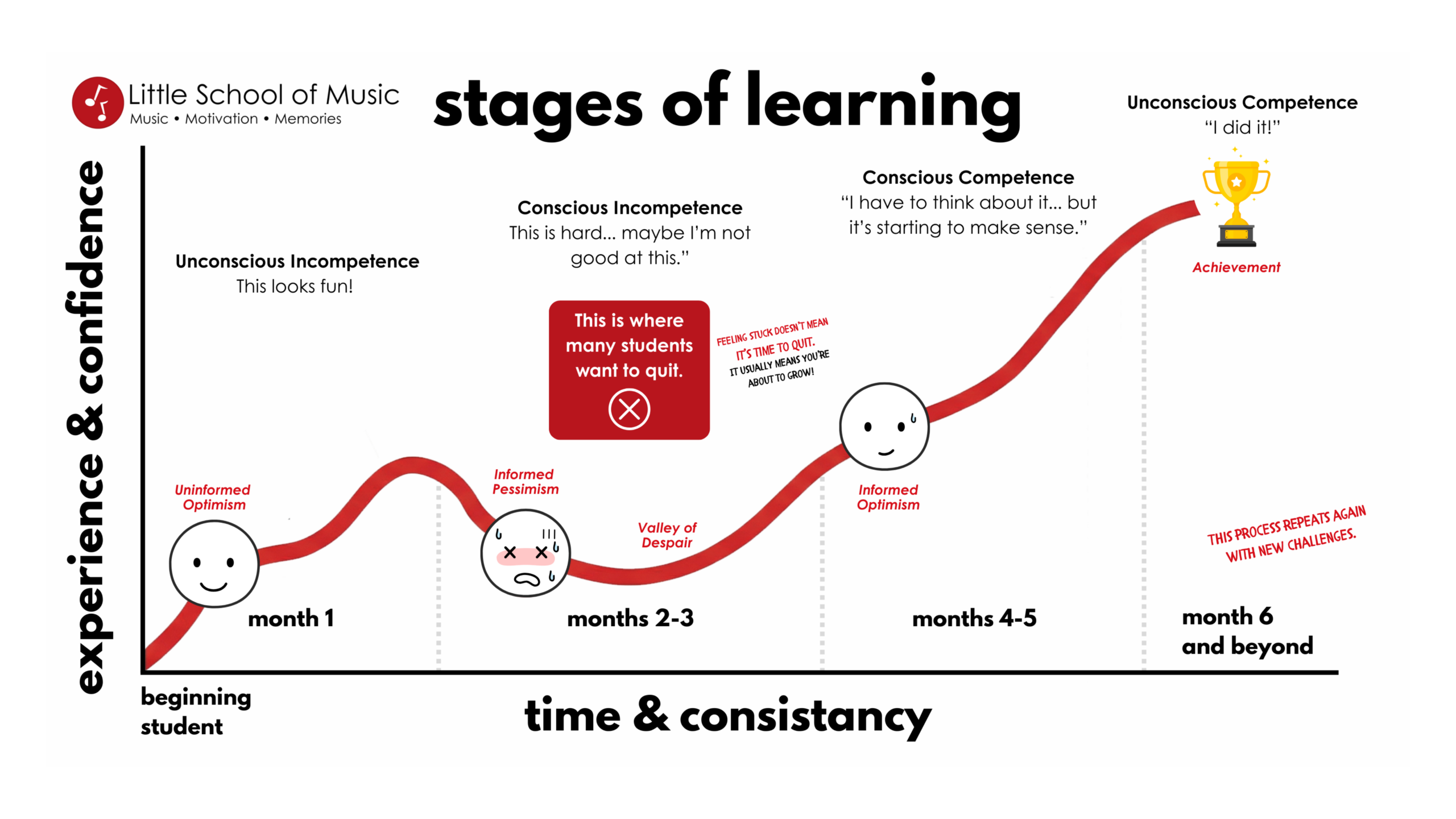
1. Unconscious Incompetence
“I don’t know anything yet, but this seems fun!”
This is when kids start lessons. Everything is new. Everything feels easy.
2. Conscious Incompetence
“Oh… this is actually hard.”
This is the stage where almost all quitting thoughts happen.
It’s not that the child doesn’t love music.
It’s that for the very first time, they are aware of what they can’t do yet.
It’s uncomfortable. It’s disorienting.
And if they don’t understand the process, it can feel like failure.
3. Conscious Competence
“I can do it, but I have to think.”
Skills grow. Confidence grows. Kids learn to navigate the work.
4. Unconscious Competence
“It’s part of who I am now.”
Music becomes natural, expressive, joyful again, but at a new level.
The problem is…
Most kids try to quit in Stage 2, right before the breakthrough.
And without adult guidance, they never learn:
- resilience
- perseverance
- how to overcome challenge
- how to move from discomfort to mastery
This is why “start-stop-start-stop” kids stay stuck at the bottom of every learning curve.
But with the right support?
Magic happens.
STORY #1: The Student Who Wanted to Quit… Until He Found Jazz
Prabhtej walked into his flute lesson one day, looked his teacher in the eye, and said:
“I want to quit.”
Instead of panicking or pushing, his teacher simply said:
“Let’s try something different.”
She placed a jazz piece in front of him, something totally outside his usual classical repertoire.
He played through the first line… then the next…
And by the end?
The smile on his face was unstoppable.
“Do you have another one like that?”
He didn’t need to quit.
He needed something that lit him up again.
That same student went on to perform solo at Carnegie Hall for his National Gold Medal in Flute Level 7.
He didn’t stop.
He simply needed a spark.
STORY #2: The Student Who Wanted to Quit… But Chose to Wait One Year
Erica had incredible parent support, musical talent, and years of study behind her.
But freshman year of high school hit hard. Academics, transitions, identity shifts – all normal.
She told her parents:
“I think I want to stop music.”
But instead of making an immediate decision, she made a wise one:
“I’ll give it one more year. If I still feel this way, I’ll step away.”
A year later?
Not only did she not quit,
She became Section Leader, then Drum Major of a highly competitive marching band.
Her senior year, she also performed solo at Carnegie Hall for her National Gold Medal in Flute Level 9.
She didn’t need to stop.
She needed to grow through the dip.
The Real Reasons Kids Say They Want to Quit
When a child says they want to stop music, it usually means one of these:
1. They’ve hit the “work” stage and don’t recognize it.
All learning has a discomfort zone.
2. They’re bored and need a new challenge.
New genre, new repertoire, new ensemble.
3. They’re overwhelmed in life outside of music.
School, social pressure, fatigue, transitions.
4. They’re absorbing parent stress.
If a parent complains about:
- driving to lessons
- recitals
- noise
- scheduling
Kids internalize it and think they are the burden.
5. They don’t feel progress, even though they’re making it.
Parents see growth week to week.
Kids feel it month to month.
They often don’t realize how far they’ve come.
What to Do When Your Child Says, “I WANT to QUIT” – Your 5-Step Response Plan
STEP 1: Don’t react emotionally. Pause. Listen.
Ask:
“What makes you feel that way?”
You’re gathering data, not making decisions.
STEP 2: Identify which stage of the learning curve they’re in.
If they’re in the “Conscious Incompetence” stage (the dip), reassure them this is normal.
STEP 3: Try a reset before making any decisions.
A reset can be:
- new music style
- new project
- joining an ensemble
- switching repertoire
- taking on a fun challenge
(Just like jazz revived Prabhtej!)
STEP 4: Clarify the intent behind music lessons.
Ask:
- “Why did we start?”
- “What do you enjoy about it?”
- “What would you miss?”
- “What do you want music to do for you?”
Children often reveal they don’t truly want to quit,
they want the uncomfortable feeling to stop.
STEP 5: Set a timeline, not an exit.
Use the “Erica Rule”:
“Let’s continue for one more season/year. If you still feel this way, we’ll reevaluate.”
Nine times out of ten, kids push through the dip and rediscover their joy.
The Big Lesson: Don’t Let Kids Quit During a Low Point
If children quit whenever things get challenging, they never learn resilience.
Music offers one of the safest, healthiest training grounds for learning:
- grit
- discipline
- emotional expression
- consistency
- problem-solving
Quitting too early steals those gifts.
Final Thought From Miss Mindy
Almost every Legacy Artist at Little School of Music, those who perform at Carnegie Hall, win national awards, pursue music careers, or keep music as part of their soul for life, has had a “dip.”
Not one of them says:
“I’m glad I quit.”
But every single one says:
“I’m so glad I didn’t give up.”
Help your child through the dip.
Their future self will thank you for it.